Showing posts with label Dr. Shaw. Show all posts

Monday, April 29, 2019

The Little Gods of Death

After spending the first two weeks of April in New York, I returned home to a stack of mail, most of which was junk, of course. But, in that pile of credit card offers and sale circulars were two packages. I opened the smaller of the two first to discover a book, of sorts. It was not one for reading, or not so much, but one for writing in. It had pages like one might find in an old-fashioned baby milestone book, with blanks for putting in important information and dates, much as one would enter a baby's height and weight, vaccinations, first steps, first words, first day of school, etc., all the details of baby's first years lovingly curated as a keepsake.

And apparently, the book I received this month is intended as a kind of keepsake too, because it says so in subtitle right there on the cover: The Healing Heart: A Special Family Keepsake, just above an embossed dedication to the memory of my father. Inside are pages upon which I am encouraged to write down the details of his funeral and burial, pages for filling in my dad's ancestry, and a page to list favorite memories. The book, a "gift" from The Heritage Company, also contains many pages of instruction and advice about how to grieve properly. Oh, and tucked handily between the cover and first page is a note listing the "caring friends and neighbors" in my local business community who funded this little project: a bank, a realty company, a water treatment service, a tire shop, a flower shop, and the funeral home. Along with the note is a booklet of small postcard thank you notes that, according to the booklet instructions, I am encouraged to send to those merchants.

I did not know projects like this, a funeral book with local sponsors (and by local, I mean my hometown of Saugerties, not Nashville, where I live now), existed. But I do know it immediately for what it is – a collaboration between the funeral home and The Heritage Company to turn a buck. And I suppose someone else might have opened the package and thought the book a nice thing to have, and perhaps might have been helped by it in their grief. But I find it creepy and a little predatory. I mean, a sponsored funeral keepsake book with accompanying instructions for grieving, along with a command to send thank you notes to said sponsors? I think I'm entitled to be weirded out by this "gift."

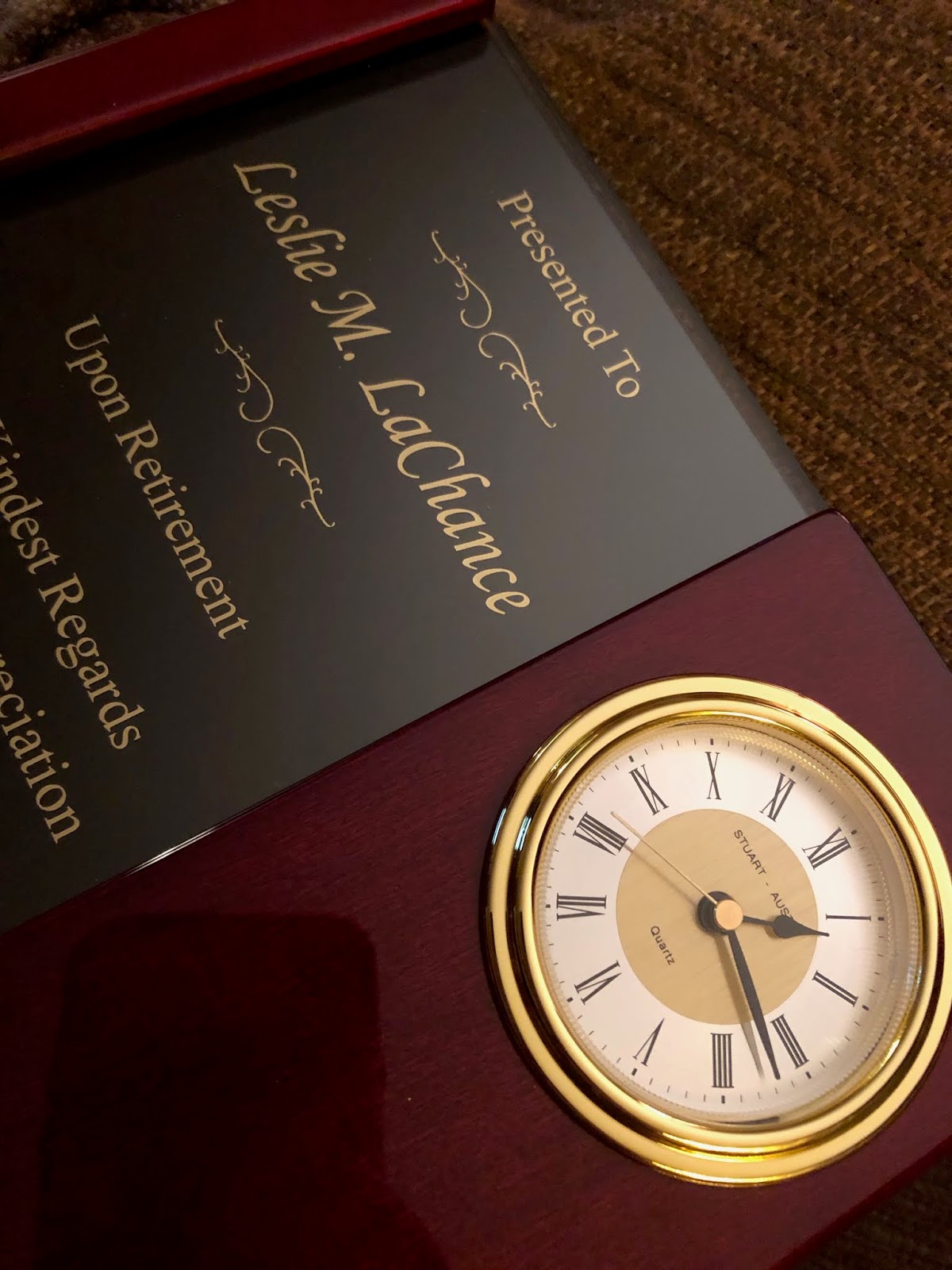
The second package, bigger and much heavier than the first, contained a desk clock. Or, to be more precise, it is a clock mounted in a piece of polished wood next to a plaque bearing my name and explaining that the clock was being sent to me upon my retirement in gratitude for my years of service in the classroom. I thought the tradition of clock- or gold-watch-giving on the occasion of
one's retirement had gone the way of the company pension plan, but no. And now here I am with an unasked for reminder of my own mortality. Tick. Tick. Tick. I would have maybe preferred an actual pension. Or if I had to be measuring something, perhaps an astrolabe. And what a strange tradition anyway. Retirement means not having to keep track of time, or at least not so very much. I wonder how many gold retirement watches got a second life in the pawn shop? My husband now and then likes to tell a story about a relative who worked her entire life in a cotton mill in a small West Tennessee factory town. She never missed a day of work, and she was never late. Of course the company gave her a clock in appreciation when she retired, and she, by all accounts, fairly relished the irony of any suggestion that she needed a timepiece.

 I suppose there's more to say here about the macabre serendipity of the book and the clock arriving at my house around the same time, these little gods of death, but I'm not going to read too much into the symbolism. It's enough that I have scans this week, and an appointment to see Dr. Shaw in Boston next week. Even without the funeral book or the retirement clock, I've got plenty to remind me that death is out there angling for me, for all of us. And what do we say to the god of death? Not today.

Saturday, November 10, 2018

The Incredible Dangling Woman

A year ago you get a phone call confirming all the suspicions. Adenocarcinoma. Lung cancer. What? How? You don't even smoke! You spiral for a bit, round and down into some seething, dark emotional pit. You dangle there in the unknown, learning the hard way (your favorite way) how nothing is certain, nothing given. No matter how hard you try to google yourself to a Ph.D. in Stage IV lung cancer, no matter how many databases you ransack for the cure, the answer is only this: you will die from this disease, probably sooner rather than later.

One morning you wake up and can barely breathe, and you think, huh, guess it's gonna be sooner. But it's not. After emergency surgery to drain the cancerous, suffocating fluid from around your heart, you start actual treatment a whole month after diagnosis, a month spent waiting for genetic clues from three different biopsies to match you to the right thing. This treatment, a pill you take twice a day, is the only FDA-approved treatment for your type of cancer, which has a rare genetic driver; only 1-2% of lung cancer patients have it, typically non-smokers. For the first time in your life, you are in the 1%. Haha. You've won the cancer lottery. And it's miraculous, because there is something for it, not a cure, but a treatment that will keep the cancer from growing, hold it in check. The treatment makes you sick as hell at first, but after a few months, it's not so bad. And it works. For a few more months. Then it doesn't. 

The tumors that were shrinking are growing again and OMG! The cancer is in your brain now! And there you are, dangling over what's next. The radiation oncologist tells you that it's going to be sooner rather than later if you don't do something, like whole brain radiation. You read up on it, and you read the studies about how whole brain radiation doesn't always work for your type of cancer, how it damages the brain, and how the cancer just comes back anyway, almost right away sometimes. You'd be buying time, but what kind of time? So you decide to skip it, even if that means sooner rather than later. 

Instead, you keep scrolling on Clinicaltrials.gov, and you call your friend who has been in the exact same situation. She tells you to go see her famous doctor and get in her clinical trial in Boston. Friends and other fellow cancer patients tell you the same. You fly to Boston, get in the trial, start a new treatment, a breakthrough medicine. It's not a cure, but an inhibitor, like the first treatment, but better, more potent. It's amazing! After a few months you have no evidence of disease; you are NED! There is still cancer in your body, but only at the molecular level, and the medicine keeps it from making tumors. Isn't that brilliant? You have no tumors! For now. For a long while you hope. You are grateful, incredibly, profoundly grateful. To science, to the doctors, to the lab mice, to your family, to your friends, to all the other lung cancer patients in your on-line support group, to all those people who put your name on the breath of their prayers. Even if your brain is a little slower and your neuropathic fingers don't work so well, those people love you, and you are glad for the gift of time you've been given to hang out with them. You look forward to more holidays, more birthdays, more coffee and lunch dates, more hikes, more seasons, more books to read, more music to hear, more cake to eat. More. More. Please, sir, you want some more.

But you are still dangling. You are the incredible dangling woman, one of many incredible dangling women and men who have ROS1+ metastatic lung cancer. Or any kind of advanced stage, incurable cancer, really. Like all of them you are dangling over the cutting edge of cancer research, for it is truly the edge, and you can't quite see what air your toes are kicking in or what is below, but you know it's there, and you are doing fine, for now. You are not out of options. Yet. You are on the cusp of something, praying the science will outpace the disease, that you will not fall off the cutting edge before there is something else to catch you. But you read the blogs, and you're on Facebook, and you know people, now, "in the cancer community", and you read all the posts from the ones who are doing fine. Then they aren't. Then a loved one posts the news instead, and it isn't good. In any other semantic universe, the word "progression" would be a good thing, some musical chords shifting, your game pieces moving across a board. But when it's in Cancerlandese, as in "progression of disease", well, will it be sooner or later?

And you have lived now a year and a day knowing what disease you have, knowing that you have beat some odds. You don't know what it means. You don't know what anything means except that you have made it, panting, to this edge. And it is rimmed with love, all those people reaching to hold you there, to pull you up. They go with you to scans, endless appointments, and hear the news, good or bad, with you. They send you tiny, funny letters in the mail, drive four hours across two states in the rain to see you in your basement studio digs in Brookline. They send you money and airline tickets and good wishes and thoughtful gifts, take trains to you through the darkness to meet you early, early. They sleep on awful cots in the hospital to be next to you, fetch you real food instead of that hospital swill, and keep everyone in the loop. They wake up every day beside you, make you coffee or tea, listen to you fret, soothe you, take you out to a show, a nice dinner. They make you eat kale (or drink it in beet smoothies). They restore you with yoga. They help you collect and organize your many medical records and hook you up with a saint-to-be for intercession. They ask all their friends what to do for you, offer cannabis and cleanses, and company. They raise funds for research and pick up your slack at work, text you with poems and prayers and blessings, with in-jokes and irony. They read your shitty, whining blog posts and like your pictures on Instagram. They let you be cancer girl, or not, whichever suits you. They lift you up in prayer. They are tender and strong, and you are puny and amazed in the light of such kindness,  such grace, such mercy. They are there with you, at the edge, not letting go, all of you crying more, all of us every day crying please, sir, I want some more!

Thursday, September 13, 2018

Hello, I'm NED!

Today's foot attire.
That's right friends! Ten months after being diagnosed with Stage IV metastatic lung cancer, nine months after having emergency heart surgery for a pericardial effusion caused by the cancer, and four months after being told I would need whole brain radiation to treat multiple tumors in my noggin, my most recent scans show NO EVIDENCE OF DISEASE. I have had a COMPLETE RESPONSE to LORLATINIB, a drug I have accessed through a clinical trial with Dr. Alice Shaw at Massachusetts General Hospital. So I'm not going to die of lung cancer any time soon. In fact, if I have a durable response (i.e. one that lasts years), something else might even get me first! In the meantime, I'm going to walk around alive and well and incredibly grateful for good science, a loving family, amazing friends, and all those who have put my name in their prayers, including some folks  I've never even met. All those things together have wrought this miracle, and I bow before them.

Even though it's a horrible thing to have cancer, and even though I had an awful setback in treatment in May, and even though I'll likely be having to treat this disease for the rest of my life, so many other things have gone right that I feel incredibly fortunate most of the time. Through a happy chain of events, I found myself in touch with the right people who had the right information at the right time to help me get access to this trial. I had the indispensable help of the ROS1ders, especially Patty, who was the first person with lung cancer to tell me I could survive it, and who is always just a phone call away. And in the couple of days back in May when I was having to make hard decisions about treatment, two of my best friends, Claudia and Rebel, swooped in to cheer me on. They urged me to pursue the trial and helped me gather and send off all the clinical records I needed to be considered for it, which involved some serious running around to multiple clinics in midtown Nashville on a hot day. It's great having your own personal cheering squad when you're terrified. Once I got to Boston, my sister Michele and two of my nieces met me and my husband John there, schlepping over on a long drive from New York after just having a long trip home from visiting me in Nashville! Another cheering squad to the rescue as John and I waited to learn if I could get in the trial. I did qualify, and that has meant monthly trips from Nashville to Boston, so again, I have been fortunate to have the resources and to have been given some generous gifts to fund my travel to Boston to follow the protocol. Not all cancer patients who could benefit from trials can get access because the sites are often far away and the cost of travel prohibitive.

So, science yes, but grace too.

And unconditional love and support from my husband John and stepdaughter Rachel for my decisions. Their good spirits, patience, generosity, and love have sustained me. Being a caregiver to someone with cancer is never easy, especially when that someone is ornery me.

What does all this mean for my prognosis? Well, I still actually have cancer. But now, we're treating it more like a chronic illness instead of a soon-to-be fatal one. Those of us in the lung cancer community know, though, that things can turn ugly quite suddenly, and no matter what the treatment plan is, we're always thinking about what could happen with the next set of scans. I'll keep taking lorlatinib for as long as it keeps the cancer pinned to the mat. If the disease gets a second wind and rises up, well, it just so happens I have a hook-up with a rock star cancer researcher in Boston who studies the disease's mechanisms of resistance to treatment, and she will, by then, have discovered more about what to do next. Those discoveries will benefit not just me, but so many others who have lung and other cancers that need to be treated at the molecular level. That, my friends, is why we have to keep pushing to make more funding available for lung cancer research. And one of these days, I'll quit pestering you for donations, because all those dollars you'll have contributed will have added up to a cure!


Thursday, May 24, 2018

Go Ask Alice

Ten days ago I a got a call from a radiation oncologist who told me that I probably needed to have three weeks of whole brain radiation to treat lung cancer metastases that had spread to my noggin. He was very kind and meant well; I said thanks, but no thanks. I don't have lots of extra brain tissue to spare, and the thought of irradiating the good tissue along with the bad gave me serious pause. The next day, with the encouragement of the good folks I have come to know in the ROS1 cancer community, I called the clinic of Dr. Alice T.  Shaw, an internationally renowned ROS1 and ALK lung cancer expert at Massachusetts General Hospital in Boston. Dr. Shaw has been running clinical trials of targeted therapies that treat lung cancer brain mets and overcome resistance to older treatments, and I wanted to see if I could get in on one of those. To my surprise, I was able to get an appointment with her for the following week!

After meeting with Dr. Shaw and her partner Dr. Jessica Lin on Tuesday this week, we determined
that I should enter Dr. Shaw's trial for a drug called lorlatinib. It has shown some success in overcoming ROS1 crizotinib resistance caused by new mutations (mutation resistance to my old medicine, crizotinib, is probably why my disease is no longer stable), and it treats cancer metastases in the brain. The hope is that if the drug works for me, I won't need to have any radiation at all, that the brain mets will resolve, and the drug will keep the metastatic cancer in check for months or even years. So today, I got my new medicine! That's me looking ecstatic in my lucky Elvis Presley Crown Electric work shirt.

I'm gratefully and cautiously hopeful. There are a few things to keep in mind, though. This medicine is a treatment, not a cure. It works for some people, and not for others. If it does work, we don't know how effective it will be or for how long it will work. The last drug I was on, crizotinib, has worked for years for many patients, but it only worked for a few months in my case. One thing we hear over and over again in the cancer community is that "each person's cancer is different" and "each person responds differently to treatment." Cancer is a designer disease, but with new targeted and immunotherapies, researchers are developing designer treatments.

To get that designer treatment and to make sure it fits, I will have to go to Boston once a month for evaluation and to pick up the medicine. While the cost of the medication is covered by the pharmaceutical company as part of the trial, I will need to cover my own travel expenses. Thankfully, I have some resources. And if the trials are successful, the drug will become a commercially available standard of care, and eventually patients will be able to get it locally instead of having to travel to a trial site.

If it appears that the medicine is not working for me, or if it works and then stops working, or, if for some reason my body can't tolerate the drug, I will no longer be able to participate in the study and will have to seek another course of treatment.

So, those are the challenges. The hope part is more obvious. We hope the drug works. We hope I can stay on it for a very long time. We hope by the time this drug stops working, there will be another treatment, or, in the best of all possible worlds, even a cure.

And of course there's gratitude, especially for family and friends who have been sending financial resources, good wishes, and prayers my way. Also, I am grateful to have had the resources to make this trip to Boston and to meet scientists who are changing cancer treatment for the better, one genome at a time.

As a person of faith, I am also grateful for the masses offered, the novena's said, the prayer lists, the woodland rituals, the sage, and the beseechings to the saints. I believe in all of it. I believe in miracles. I also trust science. Together, they are awesome!


Number Nine Number Nine Number Nine

Nine Crows I have the great privilege of saying that this month, almost a week ago on November 9, I marked my 9th year living with a late st...