Wednesday, June 26, 2019

My Bad. Or, Another Personal Essay Meditating, in Part, on the National Health Care Crisis, with Opinions Based on the Tedious Author's Experience, and Accompanied by Much Whining and Complaining

(This post is adapted and tidied up from one I included on my Caring Bridge Blog recently.)

Never assume anything. Like the fact that a referral to a provider within the same medical oncology group is to a provider who is "in network" for insurance. Because if you do assume, bad things will happen, even if you are one of the lucky ones.

Por ejemplo: Last week I was thrilled to have finally landed a consult with a wonderful radiation oncologist, one of the tops in town, who happened to have an opening when others who could treat me did not, and I got scheduled for a planning meeting for this very week! This good fortune befell me after nearly two months of waiting. And of course, any fool with good fortune knows that one must always check out the insurance situation when facing a super costly treatment. But yours truly, Assumptions Woman, did not: 1) because once Assumptions Woman signed up with this oncology group, the providers' offices did all the legwork of approvals, so Assumptions Woman had never had to check about insurance for individual providers in this group for past treatment; it just got handled by them, which was lovely and is no longer the case, and 2) because Assumptions Woman was freaking out as it had been some 50 days since her unruly Spot had been found, and she was so damn happy that she had finally gotten an appointment with a radiation oncologist, she didn't bother to ask if the rad onc was "in network."

My bad. Turns out she's not, of course. And it turns out the email regarding that fact and denying her service to me came to her office AFTER I drank her barium shake and was IN THE PLANNING CT machine and the pleasantly chatty techs were marking little X's on my body so that we could line up all the radiation beams correctly when I went in for actual treatment on July 8 as scheduled.

Every other procedure I have ever had in relation to this disease (except emergency surgery for a pericardial effusion) was pre-approved by my insurance before I could even so much as walk in the door of a clinic; I mean I couldn't even have a kleenex to blow my nose without the providers asking the insurance gods for permission, let alone a little ultra-sound or brain MRI. So, I assumed (what was that we said about assuming?) that the pre-approval process for radiation had all been done before I drank the barium and got on the planning table. Nope. We just went ahead and started the planning session without any approvals, apparently. Not sure how that happened, but I suspect poor communication all the way around had something to do with it.

So the lovely rad onc felt pretty crummy about all of that, and she's going to file an appeal with my insurance company so that she'll be able to treat me and get paid as an "in network" provider. That means she has to spend extra time dealing with nonsense, so I appreciate her willingness to pursue it. She can justify her appeal because she has some equipment and some techniques at her disposal that other providers nearby don't have (which, as I said, makes her one of the best around), and my li'l tumor, Spot, is in just a weird enough place as to be super tricky to hit with gamma rays without wrecking other important parts nearby like the small intestine and kidneys. Plus, my treatment has been way too long delayed by some things that look dangerously like incompetence or just crappy communication in the oncology group's broken bureaucracy. But, the appeal will take time, and will likely cause more delay, and if it's not approved, I'll have to get in line again with a different rad onc. Heck, it'll be time for my regular surveillance scans again before I get any radiation. Why were we doing those surveillance scans again? Oh right, to get timely treatment when progression is discovered. So much for that plan.


Thank goodness I still feel well and have no symptoms suggesting the cancer has spread. I am seriously lucky and very very grateful for that.

Several people have asked why I just don't run across the avenue and get treated at the other famous cancer treatment center in town. I am considering that, but in exploring that option, I am again confronted with some similar issues...long wait times to see providers, the prospect that some are not in network, the hassle of having all my records shifted over there, of having to tell my story again and again to new doctors, new nurse practitioners, a new bureaucracy. If I have to do it and insurance allows, I will; but I keep feeling that I'm so close to actually getting treatment with my current providers that I don't want to set myself up for another long wait time. Maybe it's something akin to Stockholm Syndrome. Of course another option is to switch all my care to Mass General under Dr. Shaw, where I am already a patient, and Dr. Shaw has indeed offered to schedule me for radiation up there. But the idea of returning to regular travel to Boston for care is somewhat daunting, especially when I know it is possible, at least theoretically, to get that care here in Nashville. Again, I am giving Mass General strong consideration and will do it if it becomes necessary. But it's just super-targeted radiation I need, not a fancy new clinical trial. At least not yet. And it's remarkable that I even HAVE ALL THOSE OPTIONS. Most people do not. Many people have none. 


For instance, take the fact that rural communities all over the country, but especially in Tennessee, are losing providers and clinics and hospitals faster than you can say "treatment delay, " in our case due to our state legislature's stubborn refusal to fully fund Medicaid and participate fully in the AHA. That puts things more in perspective. For a good take on root causes of the rural health care crisis, you might want to check out this opinion piece in The New York Times.

In all of this the main take-away for me is that no matter how vigilant and how proactive I think I am about getting care, there will always be something beyond my control, some problem I don't foresee, some detail I miss, some larger incompetency or built-in bureaucratic maliciousness that can't be overcome no matter how persistent one might be. And that worries me, not so much for myself, but for those cancer patients who maybe don't have the wherewithal to navigate this labyrinth of a health care system in the first place and have no one else to advocate for them. I am pretty good at advocating for myself, and my care is still screwed up, just when I thought I was finally getting somewhere. Imagine someone who isn't literate, or who doesn't speak English as a first language, who doesn't have a public blog to air their griefs, who has a disability or is incapacitated in some way or who has no family support? So, overall, I am still a fortunate person who has found herself in temporarily unfortunate circumstances. There are worse things. 

I just hope I don't have to drink another one of those barium shakes any time soon.

Friday, June 14, 2019

The Story of Spot and a Study

It's called disease progression, and apparently I have it once again. So says the Spot on my April CT scan, a Spot which also appeared in the same place on a PET scan in May. A biopsy last week confirmed that said Spot is metastatic. Bad Spot. Go away Spot, go.

Currently, Spot is hanging out in a lymph node on the left side of my back just below my kidney, or, to put it medically, I have metastatic lymphadenopathy in a retroperitoneal periaortic node. No biggie. It's just a little stray cancer trying to find a forever home in my body. But it looks like I am going to have to put old Spot down. Quite possibly with a high dose of radiation if an increased dose of lorlatinib, my current treatment, is not indicated or likely to be effective.

The worst part of all the recent cancer doings has been the waiting. There are appointments. There are tests. There are days between tests and appointments. Then there are more tests. Then more appointments. I've known about the potential progression since early May, but it wasn't until Monday of this week that I got definitive confirmation. As of today, we (me and the docs) still don't have a treatment plan in place because we're doing a couple MORE tests to see if the cancer has developed any new targetable mutations; then there will likely be a few more medical professional consults, so, more waiting. Sigh. I KNOW! It's SOOOO frustrating! I mean we're talking about metastatic cancer, which means it's growing, albeit fairly slowly (we hope) and, well, YIKES. This aggravatingly super slow pace of arriving at a new treatment plan isn't helping me feel better about my situation, but it seems to be typical of life in Cancerland.

So, the shitty disease is no longer stable, and I've lost my coveted NED status. BUT there are silver linings. Nope, just kidding, there aren't. Metastatic lung cancer is a stone-cold killer, and there's still no cure. If you have it, the disease will fuck with you in all sorts of terrible ways, and eventually, because it can't be cured, it will put you in your grave; that's it's M.O. I've seen it do just that to other folks. Just sayin', the terror is real, and research funding for the much-stigmatized lung cancer is scant.

So, in lieu of silver linings, here are a couple points of gratitude. First, my brain MRI shows there has not been progression to the mothership of my central nervous system, so far, so good there. Secondly, because I had a CT-guided biospy, and because the interventional radiologist who did it was able to harvest a bit of extra tissue, I am able to participate in the ROS1 PDX Research Project which is trying to develop more ROS1 cell lines for study. Right now research on ROS1-driven lung cancer is proceeding very slowly because we don't have enough mouse models to study the disease. That's because only about one percent of people diagnosed with lung cancer have tumors driven by the ROS1 genetic rearrangement. So eligible ROS1 patients are encouraged to donate tissue to the study whenever they have a procedure like a biopsy or other surgery that could yield a viable specimen. It's sort of your ultimate DIY life-saving science project. PETA friends will be horrified to know that four potential mouse models were created by my metastatic biopsy tissue donation, poor mice. Me, I'm kind of excited about the research possibilities, though I admit to feeling pretty badly about the fuzzy li'l critters. (Moment of silence here.) Thank you for your service and your sacrifice, dear little rodents.

Hey, so you knew I was going to ask, but if you want to help support this ongoing ROS1 research that could potentially lead to a CURE, now would be the time to donate to my ROS1 Research fundraiser with the GO2 Foundation for Lung Cancer (formerly the Bonnie J. Addario Lung Cancer Foundation). The findings from this study may have the potential to change treatment for other oncogene-driven cancers as well, with broader implications for cancer treatment overall. Since I donated my own living metastatic tissue to the study through a somewhat painful biopsy procedure, maybe a few readers could spare a few bucks as a kind of matching grant? Okay, that's a little gross, but you get my point.

And despite all my whining and complaining, I am doing my best to maintain a posture of gratitude and to keep the faith.

Monday, April 29, 2019

The Little Gods of Death

After spending the first two weeks of April in New York, I returned home to a stack of mail, most of which was junk, of course. But, in that pile of credit card offers and sale circulars were two packages. I opened the smaller of the two first to discover a book, of sorts. It was not one for reading, or not so much, but one for writing in. It had pages like one might find in an old-fashioned baby milestone book, with blanks for putting in important information and dates, much as one would enter a baby's height and weight, vaccinations, first steps, first words, first day of school, etc., all the details of baby's first years lovingly curated as a keepsake.

And apparently, the book I received this month is intended as a kind of keepsake too, because it says so in subtitle right there on the cover: The Healing Heart: A Special Family Keepsake, just above an embossed dedication to the memory of my father. Inside are pages upon which I am encouraged to write down the details of his funeral and burial, pages for filling in my dad's ancestry, and a page to list favorite memories. The book, a "gift" from The Heritage Company, also contains many pages of instruction and advice about how to grieve properly. Oh, and tucked handily between the cover and first page is a note listing the "caring friends and neighbors" in my local business community who funded this little project: a bank, a realty company, a water treatment service, a tire shop, a flower shop, and the funeral home. Along with the note is a booklet of small postcard thank you notes that, according to the booklet instructions, I am encouraged to send to those merchants.

I did not know projects like this, a funeral book with local sponsors (and by local, I mean my hometown of Saugerties, not Nashville, where I live now), existed. But I do know it immediately for what it is – a collaboration between the funeral home and The Heritage Company to turn a buck. And I suppose someone else might have opened the package and thought the book a nice thing to have, and perhaps might have been helped by it in their grief. But I find it creepy and a little predatory. I mean, a sponsored funeral keepsake book with accompanying instructions for grieving, along with a command to send thank you notes to said sponsors? I think I'm entitled to be weirded out by this "gift."

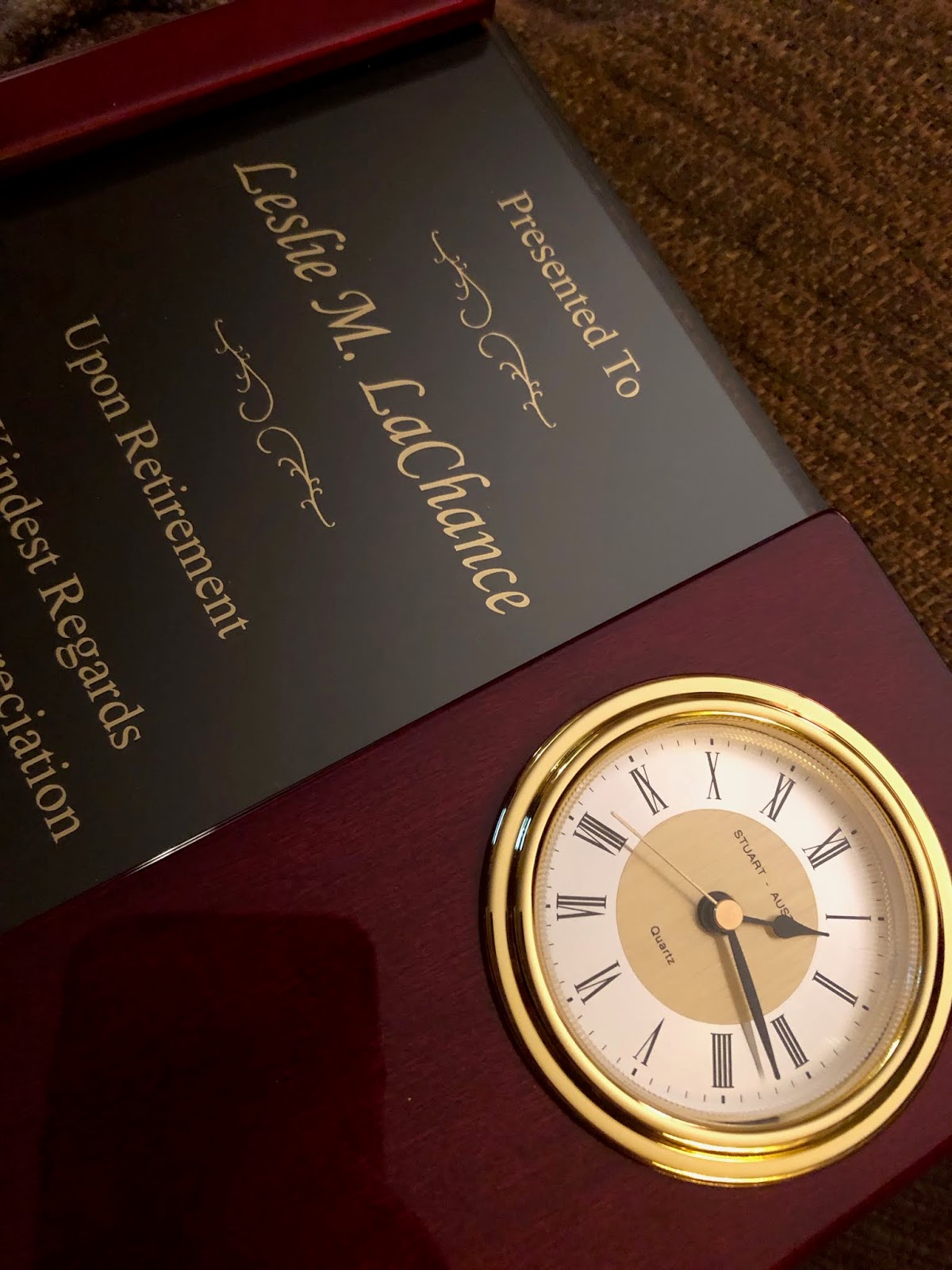
The second package, bigger and much heavier than the first, contained a desk clock. Or, to be more precise, it is a clock mounted in a piece of polished wood next to a plaque bearing my name and explaining that the clock was being sent to me upon my retirement in gratitude for my years of service in the classroom. I thought the tradition of clock- or gold-watch-giving on the occasion of
one's retirement had gone the way of the company pension plan, but no. And now here I am with an unasked for reminder of my own mortality. Tick. Tick. Tick. I would have maybe preferred an actual pension. Or if I had to be measuring something, perhaps an astrolabe. And what a strange tradition anyway. Retirement means not having to keep track of time, or at least not so very much. I wonder how many gold retirement watches got a second life in the pawn shop? My husband now and then likes to tell a story about a relative who worked her entire life in a cotton mill in a small West Tennessee factory town. She never missed a day of work, and she was never late. Of course the company gave her a clock in appreciation when she retired, and she, by all accounts, fairly relished the irony of any suggestion that she needed a timepiece.

 I suppose there's more to say here about the macabre serendipity of the book and the clock arriving at my house around the same time, these little gods of death, but I'm not going to read too much into the symbolism. It's enough that I have scans this week, and an appointment to see Dr. Shaw in Boston next week. Even without the funeral book or the retirement clock, I've got plenty to remind me that death is out there angling for me, for all of us. And what do we say to the god of death? Not today.

Monday, March 25, 2019

My Goodness, What Big Ears You Have

Lop-eared, like a rabbit, I've decided. I mean, one could have donkey ears, basset hound ears, elephant ears, even giraffe ears; they'd all be bigger than normal human ears. But I'm picking rabbit ears for imagery here because it's spring bunny time and loppies are super cute. And as of today, I am supposed to have bigger ears, so I am leaning toward lop stylings in keeping with the season. I mean, I didn't take official before-and-after measurements, but still, I don't doubt that those flappers on the sides of my head, which weren't so small to begin with, have grown a bit, especially since I've been feeding them A LOT of music and poetry these past few days. Turns out that feeding music and poetry to one's ears is the truly avant-garde method of fighting pretty much anything that ails a body, way more experimental than any clinical trial, way more effective, probably, and a lot more fun. Here's my method:

Start by going back to a city where you used to live, a place you learned to love the hard way, over time, long ago. It was a good city for living in when you were always broke and studying and making plans; rent was cheap. You survived on pizza, ramen, and beer, lived in a half-dozen different places over the years there, all of which were varying degrees of tumble-down and shabby, but full of art your friends had made. And lots of books. There were too many romantic entanglements and too many lonely months and years. When you finally left town over a decade later to go be a grown-up, your heart broke a little as you watched the mountains get smaller in the rearview.


When you get back to that city so many years later, go in for the great big genre-defying music festival which has made the place famous these days, and walk everywhere. You always did walk everywhere back in the old days, and you can again. It's the same city, better in some ways, worse in others. One way it is better...the walking. You can walk to so many bougie things you like now, shops and restaurants and galleries, theaters and music halls. The entire downtown, which had once boasted so much empty real estate, is bustling. There are things, and you can walk to all the things. Up and down, up and down the streets and hills. The weather is fine; the cherry trees are blooming; it's spring and perfect, and you walk and walk. And walk. Miles and miles before the long weekend of music is over.

Go inside the churches and theaters and clubs and galleries for all the music and poetry and art all day and all night. Sounds and words you've never heard, jazz and not-jazz, string music and space music, music wrapped around poems, and music bashing into screens and scrims. Screams and saxophones, singing and shouting, harmonium drone and happenstance, ballet and balls-out photography. Try to see and hear everything and fail because there is too much and it is impossible. Stand in line, stand in the venue, listen, walk some more. Go in again. Listen to the people playing, singing, speaking, most of whom you've never even heard of. Listen to the people talking about the people playing; listen in between, listen, listen. Listen to all the weird stuff, almost none of which you know, and if you did, now you hear it in a different way. Be puzzled and curious and surprised. Be glad and listen some more, to all the sounds, the various languages, the idioms, the words and the silences. Deal with the crowds even though you hate crowds. Embrace the too-muchness or let it embrace you. Listen for four fucking days. Be amazed and grateful that you, formerly very, very sick you, can do ALL OF THIS!

And you'll feel better because you'll have gotten avant-garde aesthetic amnesia, in-the-momentness, the real cure for, well, just about anything that needs fixing. You'll go home with a full heart and a mind twisted up like some crazy beautiful sculpture, wrapped around the love of old friends who welcomed you back, took you in, fed you pastries and cheered you on as you fed your ever-growing ears and felt yourself...healing.

Wednesday, March 20, 2019

My So-Called Memorial Tree

Last year on March 20th, John and I planted a small weeping cherry tree  in the backyard. The weather was chilly that day; rain and sleet took turns falling and calling the calendar into question. We could have put off the planting for another day when the weather was fine, but we'd bought the tree specifically to plant on March 20, the first day of spring and my 55th birthday, the first one since my metastatic lung cancer diagnosis. I was determined to get that twig in the ground. So we put on our rain parkas, dug a muddy hole, set the tree, and filled more mud in around it. It felt like an act of defiance, of the weather, yes, but also of something else, the nagging fear that tucks in alongside a metastatic diagnosis. I crossed my fingers and prayed that the tree would root well and bloom the next spring, and that I'd be around to see it. Of course, there was always that other possibility, one I didn't want to entertain – the weeping cherry could end up becoming my "memorial" tree, and its roots maybe even home to my ashes.

That's not what happened, obviously. Instead, I went ahead and had myself a 56th birthday, which I celebrated today with family and friends and neighbors on this first day of spring at one of our favorite East Nashville restaurants, Lyra. I didn't used to always go big on my birthday, but I've changed my mind about that since, well, ya know.  So carpe feliz cumpleaños and all that!

In that spirit, we had a community happy hour (actually a happy two hours) of cocktails and kabobs (cooked outside on the grill Lebanese style by Chef Hrant) and a wonderful Armenian layer cake (made by co-owner Liz, who happens to be married to Hrant). I invited lots of lovely people, and lots of them came. It was sunny and festive and kind of perfect out there on the patio honoring the Vernal Equinox. Plus a portion of the proceeds from that little party are going to The Addario Lung Cancer Foundation for the ROS1 Research Project.  So it was an entirely wonderful 56th first day of spring. And birthday.


And –
this:


Saturday, March 2, 2019

Eating All the Cake

During the first months after being diagnosed with ROS1 metastatic lung cancer, I took a daily chemotherapy pill, Xalkori, 250mg twice a day. The side-effects were crummy, not as bad as other forms of chemo, but still, I puked a bunch. I lost weight, of course; food wasn't such a pleasure, and I couldn't drink coffee or tea at all, which was a big deal to this caffeine slave. When I started in the clinical trial on lorlatlinib (now called Lorbrena), those GI adverse effects got traded out for others (ridiculously high cholesterol, neuropathy, brain fog), but my appetite returned with a vengeance. Lorbrena, it seems, not only stimulates the appetite; it puts the brakes on both metabolism and the willpower/common sense part of the brain, making a person more inclined to impulsive behavior. As in eating ALL the cake. So all the weight I lost puking on Xalkori came back fast, and then some. And that's fine. I mean, I haven't had to buy an entire closet of new, bigger clothes or anything, but my skinny jeans are having a little rest right now, and I have recently pursued a more careful diet. (Not because I've bought into the patriarchal bullshit on body type, but because it's true that carrying extra weight is not exactly the best way to fight cancer.)

I continue, however, to eat all the cake in other ways: going out to hear live music more nights than I don't; waking up the next day in a house I love, next to someone I love, and who loves me back; sitting at a table with a bunch of writers finding the best words; sharing supper, stories, and gossip with a poet who has been a friend and mentor to me for nearly three decades; tasting the latest shaved fennel salad creation by one of my favorite chef-friends; discovering yet more people my step-daughter and I have in common; sending text messages bouncing off satellites and into the hands of dear ones to make them laugh; reading any old good thing that falls into my hands; going to weekday matinees, and to Mass; taking quick road trips to hang out with the gorgeous weirdos who are my friends (and eat cake); yakking too long and late into the night on the phone with the faraway friends; watching the spring blooms unfurl themselves against still-grey skies; and napping, napping, napping. And that's just in one week! These are just a few of the lovely things I thought would cease to be too soon when I learned I had metastatic disease. And I'm getting to do them all.

I teased my husband after he retired from over three decades of teaching by getting him some business cards that read John Mathenia, Bon Vivant. Now, I'd like to get a set for myself, perhaps adding the word "Grateful" to the title of Bon Vivant. Mostly I'm grateful because in those moments when I am busy eating all the cake, I'm not thinking about being a person with cancer.


Tuesday, February 5, 2019

Shift Happens

Shift happens, and so does stability. This post has a bit of of both.

First, let me start with what hasn't changed. I still have metastatic cancer. It is still, thankfully, as far as we can tell, inactive. At the end of January, I had clean scans for the third time in a row in my seven months on lorlatinib, which, by the way, got FDA approval and an official commercial name, Lorbrena, back in November. Blues fans may now sing an adapted version of "Corrine, Corrina" and do a grateful little happy dance with me!

The only problem with the new FDA-approved-legal-and-all status is that when a baby trial drug grows up and goes commercial, one can no longer get that drug for free. Well, lorlatinib wasn't exactly "free" to begin with, since I had to go all the way to Boston each month to fetch it home to Nashville. Of course I am grateful I had the means to participate in the clinical drug trial, and to have had some generous gifts to support me in making those trips to collect this life-saving medicine. But now, oh now, that we have finally gotten my insurance company to cover this "novel" treatment in an off-label prescription (let us recall that this drug is FDA-approved for ALK cancer, not ROS1), well NOW she comes with a BIG FAT monthly price tag and a BIG FAT co-pay. I'm going to write more about the high cost of cancer treatment in another post, so for today, let's just say that I am grateful certain drug manufacturers have "compassionate care" practices in place for regular folks like me, who don't happen to have a dragon's hoard of shiny stuff on hand.

Okay, clean scans, same drug, that's the stable part. Now for the shift. I RETIRED from teaching after spending most of my adult life in the classroom.

Yes, I'm too young to retire. I don't exactly have piles of money stashed away (see the above paragraph about paying for a super-expensive cancer treatment), but I keep telling people that if I happen to be lucky enough to outlive my puny retirement savings, that might actually be a good problem to have, ya know, as opposed to the other option.

Why, you may ask, did I decide to retire if I don't have much money and the cancer is stable? Actually, it's because the cancer is stable that I decided to retire, because it is stable for now. Metastatic ROS1 is a refractory cancer, which means it becomes increasingly resistant to treatment. It's true that some people with metastatic ROS1 have been able to stay stable on a single treatment since diagnosis, but many of us have not. I'm one of latter, on my second line of treatment. I'm hoping I can stay on it for a good long while, that the disease remains stable, and that I'll be allowed to live a relatively normal life for some years to come. I also know there are no guarantees, ever. So I chose time over money. Time to hang out in Florida visiting with loved ones. Time to do a bit of writing. Time to pray. Time to cook and eat delicious, body-and-soul nourishing food. Time to nap, because, as it turns out, having metastatic cancer and taking a potent medication to treat it every day is fucking exhausting.

Rest. What a good idea! It's not one our culture embraces, what with our Puritan work ethic and fetish for wealth. Right now, though, that's what's working for me. Time over money. I spent it on this recently:


World Lung Cancer Day is About Transformation

  Hello Friends, Butterflies are symbols of transformation and beauty, as well as symbols of hope. Today is World Lung Cancer Day. It is a d...