Wednesday, April 15, 2020

Listicles from a Plague Year


Stay off Facebook, they say. Stop watching the news. Meditate. Do yoga. Use this time to X. Now is the time to try Y.

Here's a list of ten things you can do to fend off boredom, address your fears, organize your home, and be a better parent/human/pet-owner/sustainable-gardener/atheist/christian/buddhist/poet/ teacher/citizen/doer-of-anything/while-not-doing-anything during the pandemic.

Hey, List-makers!

I'm not bored. I have plenty to do. Plenty to think about.

And I'm not doing any of it. Hardly.

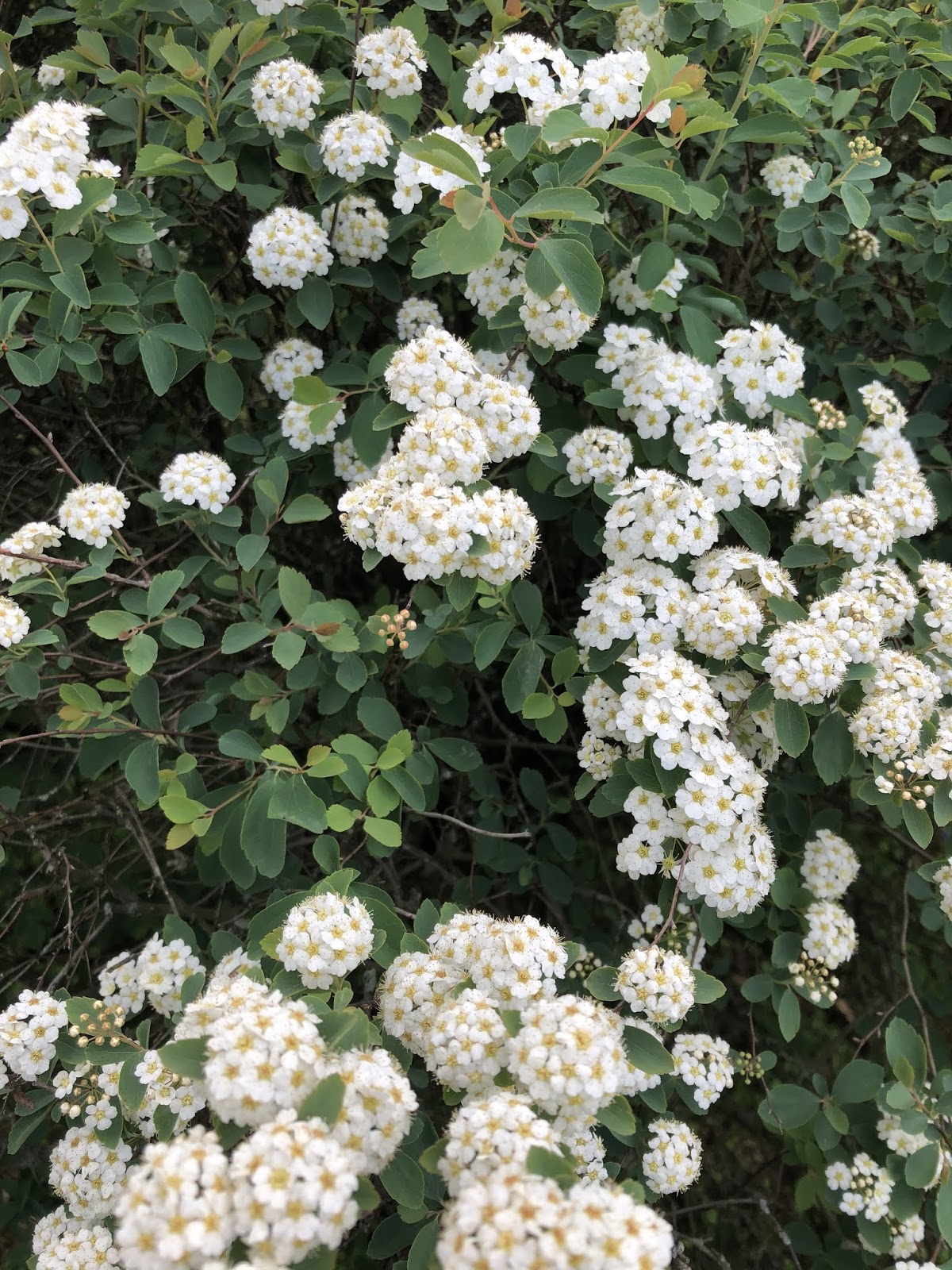
More than one well-intentioned person has pointed out to me that Shakespeare did some of his most remarkable writing during plague times. That's awesome for him. I'm socially-distance-walking around my neighborhood taking pictures of flowers and posting them on IG because that's about the extent of my mental and emotional bandwidth right now. Oh, and I'm also lecturing my FB friends on the importance of political engagement and voting. Really.

The woman who delivered groceries to my door today was at least ten years my senior. I'm 57. Let's get fucking politically engaged over that privileged cancer patient shit. How did my cancer somehow trump her seniority? Isn't she supposed to be getting groceries delivered to her, too? Damn.

Breathe. Be grateful for now. Live in this moment. Yes. Of course. I'm especially good at that. I have metastatic cancer. I'm grateful for every day I wake up. I know the future is imaginary.

Seems like lots of other people are registering that too. We can talk all we want about hope, about "after this." I do it all the time, as in "for my next treatment after this, I'll try X." But we don't really know, do we? Not really. Not ever. It just feels...more so not ever now. Weird, huh?

I still think, though, that most of us are going to be okay. Eventually. That's not a scientifically supported observation though, just a rough calculation of the human spirit left on the planet keeping it spinning. A lot of folks won't be okay though; that's true, too—I think especially of those directly traumatized by illness, and the first responders and medical folks who have had to deal with impossible circumstances. And the economic catastrophes everywhere. But somewhere, in the misty not ever...well, I don't really know. Maybe ask one of Macbeth's witches.


Sunday, April 12, 2020

Beauty Anyway

It poured rain today, Easter Sunday, drenching everything here in Nashville into a soggy mess. In some places there were severe weather watches. Some of my friends up north still have snow. As far as I know, the Easter Sunday churches weren’t packed, because they weren’t supposed
to be open. Christians who celebrate Easter today and those who will be celebrating Orthodox Easter next week, like Jews recently celebrating Passover, are compelled to keep their observances at home.

And whether or not we individually subscribe to a religious observance right now, this time of year feels like a pivot point for lots of us, as we step for real into spring, new beginnings, stirred by pretty days. Still, right now especially, we’re all terribly...uncertain about what comes next.

Because it’s Easter, I can’t help but think about what historians believe life was like for the folks who eventually became Christians in the earliest times, in the last millenium’s first decades and centuries. For the most part, those folks were Jews (and some Gentiles and others) who had, according to the various stories circulating around the Mediterranean in those days, experienced and witnessed some remarkable things while hanging out with this weird carpenter turned radical rabbi/street preacher. Or if they hadn’t seen it with their own eyes, they’d heard the tales. Their own customs and religious practices as Jews had been suppressed and surveilled by the Romans. Their holiest temple had been destroyed, rebuilt, and then destroyed again. Many of their families had lived centuries as refugees far from their ancestral homelands, and some of them living in and around Jerusalem were themselves refugees from other territories. The local and imperial governments couldn’t agree on laws; currency markets were shaky, income inequality crushed the working people, xenophobia thrived, little wars were breaking out all over, and health care sucked. You can see why a street preacher, or even a story about a street preacher with an optimistic message might have gained some traction with that crowd.

That story isn’t one to which most Americans today subscribe, though. It doesn’t bring people comfort in the way it might have even just a few generations ago, and there are lots of good reasons for that, which I won’t get into here. Let’s just say the cruelties inflicted on others in the name of that radical rabbi/street preacher have pretty much discredited most institutions trying to stake a claim on his story.

And yet some people have faith. It might not be a religious faith, but they believe in goodness.
They believe in beauty. They believe in the power of a seed to germinate into something beautiful, something edible, something tall and shady, something wild. And now, now is the time for sowing, friends. Get your beauty planted, people; we’re going to need it in the coming days.

Humans crave beauty. It’s one of the reasons I take so many pictures of flowers. It’s why we paint, or sing, or write poems, or dance. Beauty is its own life force. I think that’s one reason so many cancer patients turn to art when they fall ill, when they are dying. In the ugliness of illness, in the destruction of our bodily temples, we reach for good, and we long for beauty.

It’s my third Easter since diagnosis; my third year of snapping pictures of blooms, of dealing with pollen allergies. It’s my first living with threat of coronavirus. I can’t see far enough into the future to know how that one is going to end, so I’m going to try doing what has worked for me in dealing with cancer. Train my eye on the beautiful and pull it in. That doesn’t mean I’m not acknowledging or caring for the things that are not beautiful; I live with a hideous disease deep inside my body and see awfulness in my community every day. It’s grim stuff and it needs fixing. But that doesn’t mean that we can’t have beauty anyway.


Tuesday, March 24, 2020

Buzzed

In the past week on my social media accounts, I have added my voice to the shrill, to the complaining and impatient, to the fearful. We're all sounding the same notes. Yes, I'm a little afraid. I'm anxious. Like all y'all, I've been a bit cooped up in the days of COVID-19 and spring rains. We're also fretful about the well-being of the good folks we know who work in healthcare. All the very good advice out there on how to deal with isolation, summon equanimity, to live in the reality of pandemic times is, after all just, advice.

Yoga practice. Check. Going for walks. Check. Washing hands and staying home (except for solitary walks and the very occasional grocery forage), yes and yes. I'm catching up on reading, on those little projects around the house, etc., etc.

As a cancer patient, I've had some experience with social distance, keeping a low profile after infusion chemo, and I'd be lying if I didn't say that I kind of love it, at least without the infusion chemo part. It looks good on me. But I know it's awful for others who have lost work, who have had to adjust to working at home, who have to suddenly become school teachers to their kids AND figure out their economic lives. I know I'm fortunate to be able to work from home and not to have to worry about the educational well-being of little ones.

I'm not bored. Even scaled down and closed inside the four walls of my bungalow, my life manages to be over full and pretty content.

But there's a buzz I can't tune out. It's that conversation we're being forced to have, the one about who gets access to which resources. Who gets tested and who doesn't? Who gets treatment, and who doesn't? You've read and heard how the elderly, the "infirm", those with cancer or other serious illnesses find themselves among the unchosen, in respiratory failure and left to die so that those with more "prospects," the younger, the more "fit," get access to one of the too-few machines that could save a person's life. That buzz is so loud. It's a conversation too about the failure of policy, of the current administration's inability to understand and apply basic science in shaping a national response to our current circumstances. There's a recklessness in how the people in charge communicate, and an insidious divisiveness that spells out doom. I hear it even inside the brick and plaster walls of my cozy little house. It gets louder and louder and louder.

My health is good AND I have metastatic disease. I can say those things together because my last scans showed that I have no active cancer in my body, and I have no other acute illness at the moment. But my health is also fragile. Because my body is busy trying to keep the cancer suppressed with the help of daily oral chemo, and because I've undergone more aggressive treatment with chemo and radiation, I know my immune system is maybe not in tip-top shape. So, yes, I'm being super careful, and as I said before, mostly staying home.

NED. Clean scans. And I just had a birthday, my third since a Stage IV cancer diagnosis had me believing I might not last the year. My oncology team and I have worked hard to get me here. My health insurance has shelled out an awful lot of dough to keep me alive. While I love irony in a good book and appreciate satire in a late night monologue, I don't want to be the main character in a narrative that has me dying from the opportunistic infection of a little virus after pushing back a metastatic disease. I'm doing my part to stay safe. I just hope everyone else is too. Because that is all I've got.

Tuesday, March 17, 2020

My Very Own Three-Card Monte

I grew up about a hundred miles north of NYC, in a mostly rural area dotted with small towns. When I was a kid, my family would make regular trips into "the city" for various things, mostly entertainments like Broadway shows, baseball games, and museums. Later, when I was a ne’er-do-well teenager,  I spent time in the city hanging out with friends — going to clubs, shopping the thrift stores, rummaging used book and record shops, copping a little weed (or something stronger), or just wandering around the streets to check out the action. Always, always, always in the 70s and 80s there were con men (and a few women) running street games of Three-Card Monte. They'd set up their quick-folding tables where the flow of pedestrian traffic brought plenty of suckers their way.

The players’ banter and jibes and the quickness of the easy game captivated passersby. It was a little thrilling, all the hustle. We didn't have street cons like that where I came from. The crowd would look on, always convinced we could track the money card (or the shell covering the pea) with our eyes. Sometimes we could. Sometimes we couldn't. The point was to make us BELIEVE we could win this oh-so-simple game, to get us to lay our money down based on that confidence. Of course it wouldn't have mattered what we'd tracked with our eyes, because sleight-of-hand always made sure the operator (who could disappear into the crowd as fast as his table clicked closed) was the real winner. My friends and I played only vicariously, not eager to part with our hard-earned restaurant tip money, but we watched lots of other folks lose their dough, and often their cool.

Now, I feel a little like I'm living in a Three-Card-Monte kind of world, in reverse. I don't want to find this particular money card, or this pea under the shell, not if it's coronavirus.

Here are the corona-con's distractions: Some people might be naturally immune. Some people might have acquired immunity already by having had a case, even a mild one, of COVID-19. Some people have symptoms. Some people have none.

But we can't tell who has immunity, who has a mild case, or who might be a carrier just by looking at them. With all the cards moving so fast, we can't track the money card; we can't guess what's under which shell. Testing is still not ubiquitous, and until it is, we won't have good counts on the number of cases and who has what, where or when.

We're told the elderly and the immunocompromised (hello...I'm sitting right here!) are most at risk. It's accepted. It's medical science. The numbers so far don't lie. Here's the creepy thing: we're lots more okay with the notion that the old and sick are more likely to die than we would be if children and infants were particularly vulnerable and we suspected that their parents could be the carriers. The calls for lockdowns would be taken much more seriously if children and babies were in jeopardy, and fewer people would be calling this latest pandemic a hoax. Thank goodness it appears that children aren't as much at risk, and thank goodness schools are closing so we don't have to test that theory. Too bad so many people are really in need of lessons on public health and herd immunity.

But really it's quite simple. Chances are you know and love someone old, someone sick, someone with cancer. Chances are you love someone, period. I really, really hope someone loves you. Chances are you have friends, or, at least, a pet fish who needs you alive and well. And chances are you could be a coronavirus carrier. You might get COVID-19. You might not. But you could give it to someone else who really doesn't need it. Or you could get it and be too sick to take care of your pet fish.

Let's not suddenly fall in love with Natural Selection and Survival of the Fittest. Be your best compassionate, human, thinking self, and do the right thing.

I'm not asking you to panic. I'm just asking you not to fall for the short con. You think you're tracking the money card, but the house always wins.

Love your neighbor (or immunocompromised Auntie). From a distance. Keep calm. Wash your hands. Stay home if you can. When you do go to the store, leave some bread, milk, and toilet paper for the rest of us. Thanks!


P.S. On top of trying not to catch the coronavirus, I have scans this week, so ya know, no stress. My rad onc's office called and said to go ahead and get my CT and MRI as scheduled, but that if I wanted to get my results by phone instead of coming into the clinic, the doctor would be glad to call me. That's the prudent thing to do of course. I adore my rad onc and hate to give up a chance to say hello in person. Still, in the interest of public health, it's probably best to circulate outside the home as little as possible. Here's hoping her phone call brings good news.

Saturday, February 1, 2020

AND...WE'RE...


That's what the doctor and the NP said about my most recent CT scans. In other words, we've got continued clear scans two months out from combo chemo, no evidence of disease in the chest, abdomen, or pelvis. In other words, as far as we know, our crapshoot of going with a combination oral/infusion treatment for which there is no actual protocol nor much research data has worked to push cancer far enough back into my molecular being that it is undetectable by any tests, at least from the neck down. We'll find out what's happening in the brain with scans in March, but things seem to be okay up there so far (no symptoms). Of course we won't call this response to treatment a "cure" because the disease is metastatic, and there's a good possibility of recurrence, but it doesn't hurt a girl to wish that if the cancer cells decide to mutate again, it will be into something harmless.

Gratitude, gratitude, gratitude for all the prayers, good wishes, and adorable animal videos. I love science and the people who practice it (thanks docs, nurses, techs, researchers, acupuncture, massage, yoga, and Al). I love faith and the people who have it (and those who don't). I love my family and friends for walking through this minefield with me, carrying me when necessary, unasked, because that's just what they do and how they are made.

In the meantime, I'm back on a full dose of lorlatinib (oral chemo), which means: neuropathy in my hands, sludge in my brain, and uncontrolled weight gain (again). So if I seem a little aphasic in conversation as I try to find words, if I'm horribly forgetful and tell you the same story again and again, or don't show for an appointment, and if I seem to be suddenly QUITE LARGE since the last you saw me, it's the lorlatinib folks. Hey, it's that or letting the cancer run rampant. I'll take a little forgetful roly-poly any day over that.

With further grace, a continued period of stability will allow me to do a few things I've been looking forward to: 1) spending time with my far-flung peeps, 2) leaving the country a few times in the coming election year to get a break from the current White House administration's corrupt abuse of people like me and those I love 3) advocating for others with lung cancer 4) writing about the interesting folks I get to meet along the way. 

We. Are. Good.

And profoundly grateful.


Wednesday, January 29, 2020

You Can Call Him Al

Today I met Al. Al is the guy who calls me up every six to twelve weeks or so to remind me of the scan appointments I have for the next day. He is always so pleasant on the phone, and his voice is just beautiful – musical and full of laughter, with just a bit of an accented lilt that sounds like the Caribbean. When he calls, we end up having these interesting micro-conversations (he can't talk for long, of course, with that huge list of oncology patients he has to call) about things like the best place to get breakfast after scans, or astrology (we have close birthdays), or what we'd do if it quit raining outside and how it rains differently in different parts of town. He makes his calls from an interior office at the imaging place, so since he's not at the front desk and he's not a tech, I never see him.

Until today! Our paths crossed in the hallway, and I heard his unmistakable, beautiful voice. "Hello Ms. LaChance, good morning! How are you?" "You're him! You're my guy! You're Al!" Turns out he'd heard me in the hall and popped out to say hello, as he sometimes does with his regulars. For me it was kind of like meeting a rock star. The Nice Man on the Phone. I mean, in a world where much appointment reminding is automated, it's kind of cool to be buddies with The Nice Man on the Phone. Seeing him and the lovely techs reminds me of how grateful I am for the work they do. Even on the busiest clinic days, these folks are professional, gracious, and well, just sweetly human while being rock stars in their own way, and I am honored to know them and to be cared for by each of them, including Al.

More scan news tomorrow. Stay tuned.

Sunday, January 5, 2020

Cartographies and Cancer

I love maps. I love how each offers the cartographer's idiosyncratic vision of a place. We can map pretty much anything. Houses on a historic walking tour. Stars in the winter sky. The way from The Shire to Mordor and back again. Maps are imaginings of space, stories told or poetry made with lines and dots, numbers, esoteric symbols, and legends. We can't resist tracing them, moving our imagined selves across that imagined space with our fingertips. The map you see here, one of my favorites, traces the meander of the Mississippi River between Cape Girardeau, Missouri and Donaldsonville, Louisiana, showing how its course shifted (and implicitly is still shifting as I write) through the millennia. I'm captivated by the ribbons of pink and deeper pink, by the blues and greens curving and arching in great horseshoes through the Mississippi's capillaire Delta in a sensual visual rhythm. It’s a plotted design that looks abstract from a distance. The map here is a portion of a much larger iconic map that lots of other folks I know love too. In fact, poet and friend Heather Dobbins used it in the cover design for her book River Mouth. On seeing the map hanging in my dining room, another dear friend, Rebel Reavis, suddenly recalled that Donaldsonville was where her parents had met for the first time. Pretty much anyone who comes to my house finds themselves drawn to the map and remarks on it. That bit of cartographical magic has resonance, I tell you!

We take way-finding mostly for granted now, thanks to GPS. But we can imagine what it's like to travel in unfamiliar places without any map at all. How would we get where we wanted to go? All along the route we'd have choices to make, to go left or right, to go uphill or around the bend, to take the road more or less traveled, to move forward or stay put. Or go back. And we’d ask directions of people who know their part of the path, but not necessarily the whole route. Would we be lost? Maybe a little frustrated? Maybe, sometimes, very afraid?

In Advanced Cancerland there is no map. We might say things like "mapping the cancer genome" and declare it will lead to a cure. That's partly true. Though the cancer genome does not comprise the entire strange continent of this illness, it is at least a highly influential principality. But as far as navigating the whole landscape, from diagnosis to cure or, ugh, death, well, we're making that map as we go – testing blood and tumor tissue to find a treatment path, scanning, making new treatment choices when others fail and few or none of the options are all that good, taking direction from physicians and researchers who know their part of the route, but not the whole way there.

Sometimes the journey feels more like a game of Chutes & Ladders. We spin the dial, go a few spaces, get a chance to ascend the rungs, only to find ourselves on the next turn sliding back to where we'd begun.

Things in my part of Cancerland are actually going well at the moment. Just before Christmas I got the happy news that my particular brand of cancer looks like it’s going into remission in response to infusion chemo and radiation. So that was a great Christmas gift! I am grateful to my awesome team at Tennessee Oncology-Sarah Cannon Center – my oncologist Dr. Melissa Johnson, N.P. Lauren Welch, Dr. Casey Chollet-Lipscomb my radiation oncologist, and all the nurses and techs who helped me get through these latest treatments. I am of course profoundly grateful for all my family and friends who loved and took care of me, cooking, cleaning, etc., and to those who sent good vibes and put my name in their prayers. This remission allowed me to untether from the infusion clinic and to have a really good holiday with people I love, which is something I never want to take for granted again.

Of course we have no idea how long the remission will last. For now, I’m back on a full dose of the oral chemo, lorlatinib, in hopes that it will keep the disease in check. And we have a plan in place for if it doesn’t, another clinical trial, the next turn up ahead on the treatment path. But I won’t say lots about that right now, because if all goes well and the remission remains stable, I won’t need a new treatment plan for good long while.

I know how fortunate I am to be here in Remissionhaven for a second time. Many people with cancer never get here, and many who arrive don’t get to stay, as I well know. In the past couple of months, I’ve lost two dear friends, one to ovarian cancer and one to breast cancer, both of whom had experienced remission and subsequent recurrence. Their recent deaths are part of the reason I didn’t crow about my latest remission as I did the first time it happened. Grief and fear.

When you have a rare cancer best treated with cutting-edge medicines and you’ve reached that edge, everything begins to feel a little...improvisational, a little fluid. There is no cure, yet. Treatments are a kind of Hail Mary guesswork.  From where you stand now, you figure you’ll have this disease for the rest of your life, and there is no map for a way forward, only imaginings. Maybe the cartography of a life with metastatic cancer could look something like the Mississippi’s meander, looping over itself, finding a way, shifting over time, lots and lots of time, flowing and flowing.




World Lung Cancer Day is About Transformation

  Hello Friends, Butterflies are symbols of transformation and beauty, as well as symbols of hope. Today is World Lung Cancer Day. It is a d...